9 min. read CEO blog
How We Built an Enterprise-Level PrestaShop Framework in 2021: An E-Commerce Solution Delivered Twice as Fast and at Half the Cost

In the previous post, I wrote about how we lost some clients and got them back, even if we were expensive. Our company’s success was developed thanks to returning clients and correctly making technological decisions – an area where I still consider myself strongest.
Our growth started with those choices, which meant we had to standardize the PrestaShop system we were working with and turn it into what PrestaShop is only now beginning to offer – an Enterprise-level solution.
The COVID period, when everyone suddenly needed an online store immediately – or even better, yesterday – highlighted that e-commerce maturity in Lithuania had reached a level comparable to that of Western Europe or the US.
I mean in terms of appearance, sales promotion tools, shopping convenience, checkout, etc. What did that mean? This meant that every online store owner stopped experimenting and imagined their store as some unique piece of art they could only understand.
At first, everyone wanted uniqueness – for things to move, flash, and be different from others. Everyone enjoyed it in their own way. But was that the right path? Our expensive research studies, which cost thousands of euros annually, and our experience with foreign markets showed that, in reality, online stores (especially in particular niches) offer the same user experience.
How can that be, you ask?
Why Did We Rethink PrestaShop Before Everyone Else Did?
A single user experience became the standard because visitors to an online store shouldn’t have to stop and think: “So how do I use this?” Research showed that familiar placements and typical layouts for menus, products, and category pages reduced the time visitors spent trying to figure things out, and indirectly boosted sales. In other words, the customer is focused on your product, not hunting for a flashy, hidden menu button.
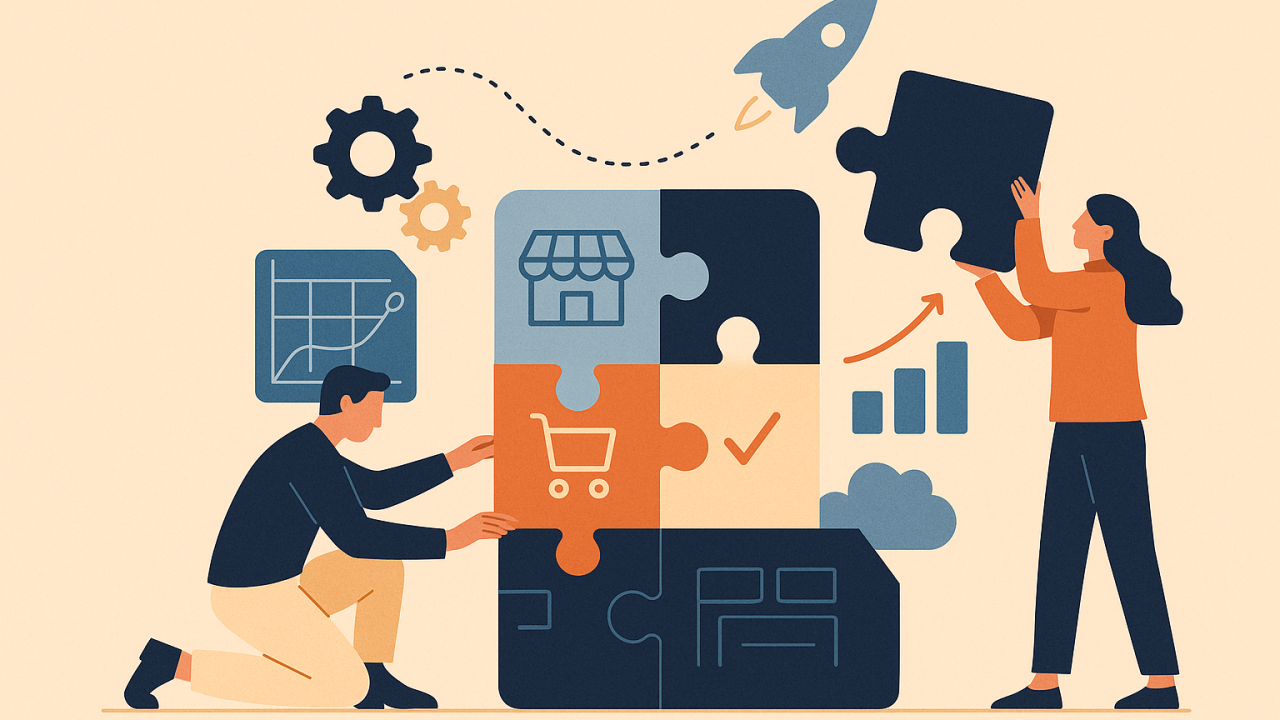
This meant that online stores essentially became structurally quite similar and even identical. A good comparison would be buying a house in a neighborhood where all houses follow a proven floor plan. Architecturally (in layout, room placement, size), all homes are the same, but each interior is customized.
That’s exactly how we saw our clients’ expectations and needs.
A typical online store – operating in Lithuania’s largest shopping centers, with discount pricing, a loyalty system, and at least ten thousand products or even a B2B section – follows very similar business models, for which that kind of architecture fits perfectly. The differences are minor, niche-based, and dependent solely on the business’s segment.
It would be correct to say that a typical online store business, launching its second or third online store and aiming to earn money, needs nothing more than such a “house.” Not only is it enough – applying our know-how, it was sometimes even too much.
From this market understanding and nearly a decade of programming experience, I decided to elevate PrestaShop to a higher standard than it was. During COVID, we began developing our unique competitive advantage – the PrestaRock framework – based on the most popular marketplace platform.
I can confidently say that what PrestaShop plans to introduce in 2025 as their PrestaShop Enterprise solution – we’ve already been developing for a good five years – effectively elevates the entire PrestaShop system by three levels.
Step One – Making Life Easier for Store Owners
It’s no secret that nearly all our competitors create unique solutions or use third-party themes. Most often, it’s the latter – everything in the demo looks great before you buy a €100 template, until you do, and realize you bought a pig in a poke.
Complicated and user-unfriendly menu management becomes impossible for a regular online store administrator with no programming skills. Banner sliders with animations are hard-coded with no control panel, meaning you need a programmer each time you want to change them.
And that’s not even mentioning that, even with a basic installation, you still need standard modules to launch correctly. We planned to gradually replace all third-party modules with our own, offering more capabilities, easier administration, no need for a developer, and intuitively understandable.
We created all of this based on accumulated experience, client complaints, and dissatisfaction with PrestaShop and its modules, which meant that we were already meeting the expectations and desires of PrestaShop online store owners. We made the PrestaRock framework’s back-office interface irreplaceable.
Step Two – Optimizing for Sales
Since I have always wanted to be the best specialist, I have carried the same success model from programming to project management and analysis. External training on TOC, LEAN, and others helped me understand that the most essential thing in business is to earn money. It simultaneously helped me systematize, standardize, and identify recurring successful patterns in what worked in online stores.
The experiences of our largest clients in Lithuania and the US and monitoring their sales provided even more insights into what truly affects revenue and what’s just textbook advice that doesn’t lead to bigger baskets or more orders.
After receiving positive feedback on administration and solving that issue, we moved on to the question: What can we add to standard PrestaShop to help clients earn more? My desire to be the best transferred to my clients – I wanted them to become market leaders and earn the most.
So, I began combining real sales experience with research and trends to advise clients on how to structure their homepages. I helped them understand what must be on a product page, category page, and checkout flow to help customers discover their products, make purchase decisions, and – once decided – not run off to a competitor.
Over a couple more years, our PrestaRock framework grew to include our own time-tested, self-developed modules that allowed stores to truly generate profit – a store that wasn’t just a checkbox in a company’s project list (“yes, we have an e-store”) – and this was already happening in ~2021–2022!
We already had an alternative to the PrestaShop Enterprise solution they’re offering this year – a curated, tested, compatible set of modules.
Step Three – Reliable Support and Updates
A common mistake store owners make is thinking that just creating an e-store is enough – that now, money will start flowing. I like to say – and understood already back then – that an online store requires constant maintenance and development.
Development isn’t just about picking the right administrator – someone who guarantees success or leads the store to stagnation – but also about technical support.
The third step that made our framework irreplaceable was optimizing, upgrading, and implementing functionalities using best practices to ensure long-term maintainability, scalability, and updatability.
But we didn’t stop there – after implementing all the essential improvements, we enriched our framework not only with our PrestaRock support contract (ensuring a response time for critical bugs of 1 hour during business hours and 4 hours after-hours, plus free updates and consultations) but also with additional plugins that enabled a properly developed store to earn even more.
Solutions that bring customers back, encourage repeat purchases, offer loyalty programs, and increase average cart value have become standard in our PrestaRock base package, effectively covering the entire customer journey in the e-commerce development process.
The Result – A Solution Twice as Cheap and Implemented Twice as Fast, or just a PrestaShop on steroids
By the end of 2022, having resolved all major problems faced by store owners, we could confidently say we were technologically ready to scale and offer a unique product.
We had a solution with a completely different technological foundation: high-quality, cost-efficient, and easily extendable, meaning that store owners could quickly adapt it to their processes, market changes, or additional needs.
At the same time, this solution costs half as much as a fully custom solution and could be implemented almost twice as fast. The sooner you can start selling, the sooner your investment in the e-commerce store pays off. Is the store optimized for sales, encourages returns, and boosts order size?
All we needed now was people, which meant hiring again but differently this time. How did that go? I’ll cover more of that in the next few posts.