
5 min. read CEO blog
When Work Becomes Just a Place to Spend Time. For Money.

In recent weeks, I have written about how I view work from the perspective of an employee. Today, I want to flip the lens: how, as a manager, I observe the way many employees think about work — the reality as I see it.
We continually explore new ways to enhance employee conditions. Lithuania may become one of the first countries in the world to officially adopt a four-day workweek. At the same time, the minimum wage rises every year, often faster than productivity. Prices rise as well. But does purchasing power really increase?
Across Lithuania — and just as much on LinkedIn — we are shaping a work culture that emphasizes not overstraining ourselves and working only as much as we feel able to. “I’ll do as much as I get around to.” I’ve even seen events in Vilnius focused on how to include even those employees who are unproductive or fall behind..
I didn’t attend the discussion and couldn’t find a recording, so I can only react to the headline. But it raises a question: should companies always focus on retaining employees who struggle to be productive? Or shouldn’t such employees simply do a job where they can contribute more effectively? Especially now, when AI technologies can already take over part of the workload.
I agree that we shouldn’t be working overtime and that free time is better spent on self-expression and growth. I also agree that it’s a personal choice whether to learn and improve skills outside of working hours. Some build their careers quickly, while others do so more slowly. I agree that younger generations are more vocal about their feelings. That expectation has to be heard, and sometimes all it takes is a hand on the shoulder and not pushing too hard.
Still, this culture also creates a narrative — reinforced by consultants — that such expectations are normal. And we should remember: consulting itself is a business. So, what’s easier to sell? Training for a profit-making company with resources, or programs tailored for a broad workforce that often lacks motivation or financial capacity?
The result is that, for some employees, the workplace turns into a place to pass time rather than a place to deliver results. The belief grows that no one should measure their performance because “I’ll do as much as I get around to.” In other words: “Whatever I manage to do should be enough — my salary must go up every year regardless.”
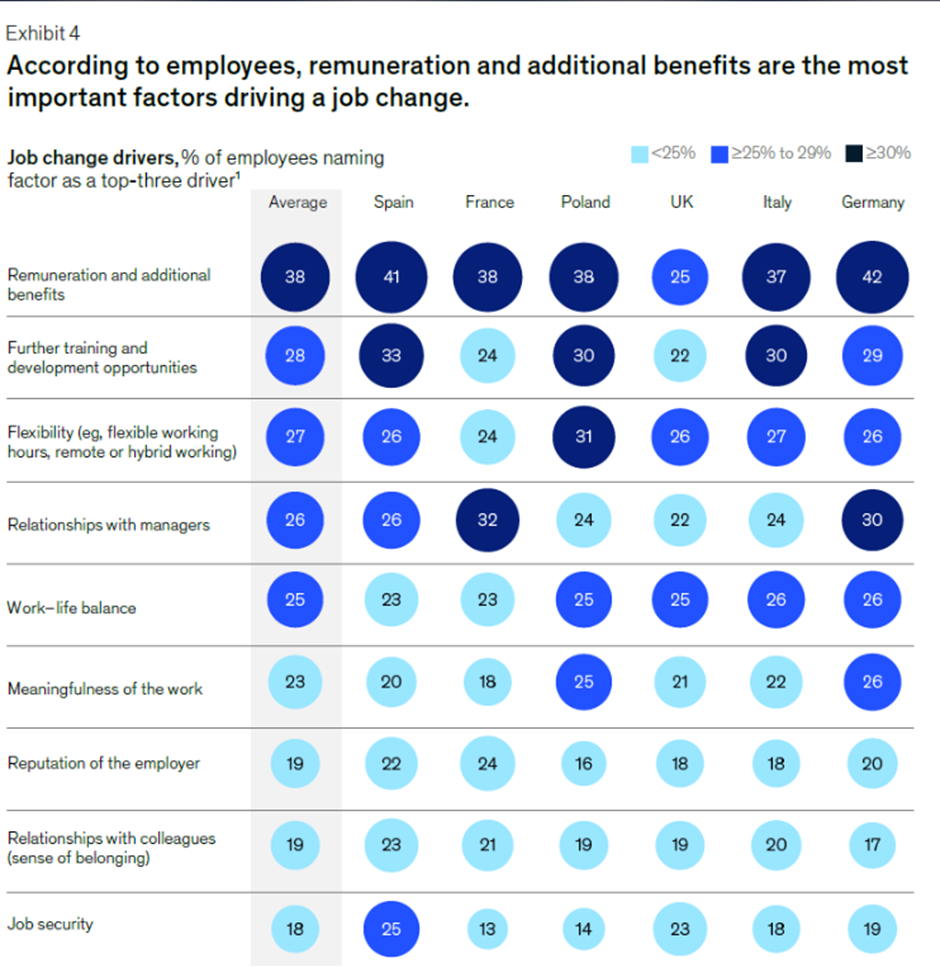
We often hear the expectation that employers should provide everything: training, mentors, health insurance, psychological support — regardless of personal performance. Another common demand is the right to work from home, where working hours blend seamlessly with daily routines, such as picking up kids, attending sports, doing housework, and even pursuing hobbies.
All this would be easier to accept if employees actually worked eight full hours when coming to work. Dainius Dundulis, the founder of one of Lithuania’s largest retail companies, once said: “If an employee spends three out of eight hours playing games at work, I’ll only pay for five.” (source) Not long ago, this logic seemed obvious. But how many hours do we really work today? Isn’t it already closer to a four-day work week?

In reality, in some companies, employees work effectively only four days, even if they show up for five. I’ve seen it firsthand: we once shared an office with such a company, and by 3 p.m., most of the staff had left. The rest of the time was spent in meetings or around the coffee machine.
I have no doubt that in many other companies, where performance isn’t measured by actual productive hours, the same is true. The problem is simple: people still come in five days a week, but the output often equals that of a shorter work week.
Still, this year’s LOGIN conference finally brought a more realistic voice: work is, above all, a place where you come to create results.. One speaker clearly pointed out that managers and HR departments often become overly lenient toward employees.

So what happens when these two perspectives collide? The usual answer is: hire an HR professional who is supposed to “fix everything.”
How did that work out for me? I’ll share in my next post.